Celebrating the AO Trauma NA 2024 Fellows Research Grant Winners
We are thrilled to announce the winners of the AO Trauma North America 2024 Fellows Research Grant! This prestigious funding is awarded to support innovative clinical and translational trauma-focused research conducted by fellows at AO Trauma NA-sponsored sites across North America. These projects represent the cutting edge of trauma care, with the potential to make significant advancements in the field.
If you’re interested in applying, the 2025 grant applications will open in the Summer of 2025—stay tuned for updates!
Now, let’s shine a spotlight on this year’s winners and their remarkable research projects:
Meet the Winners
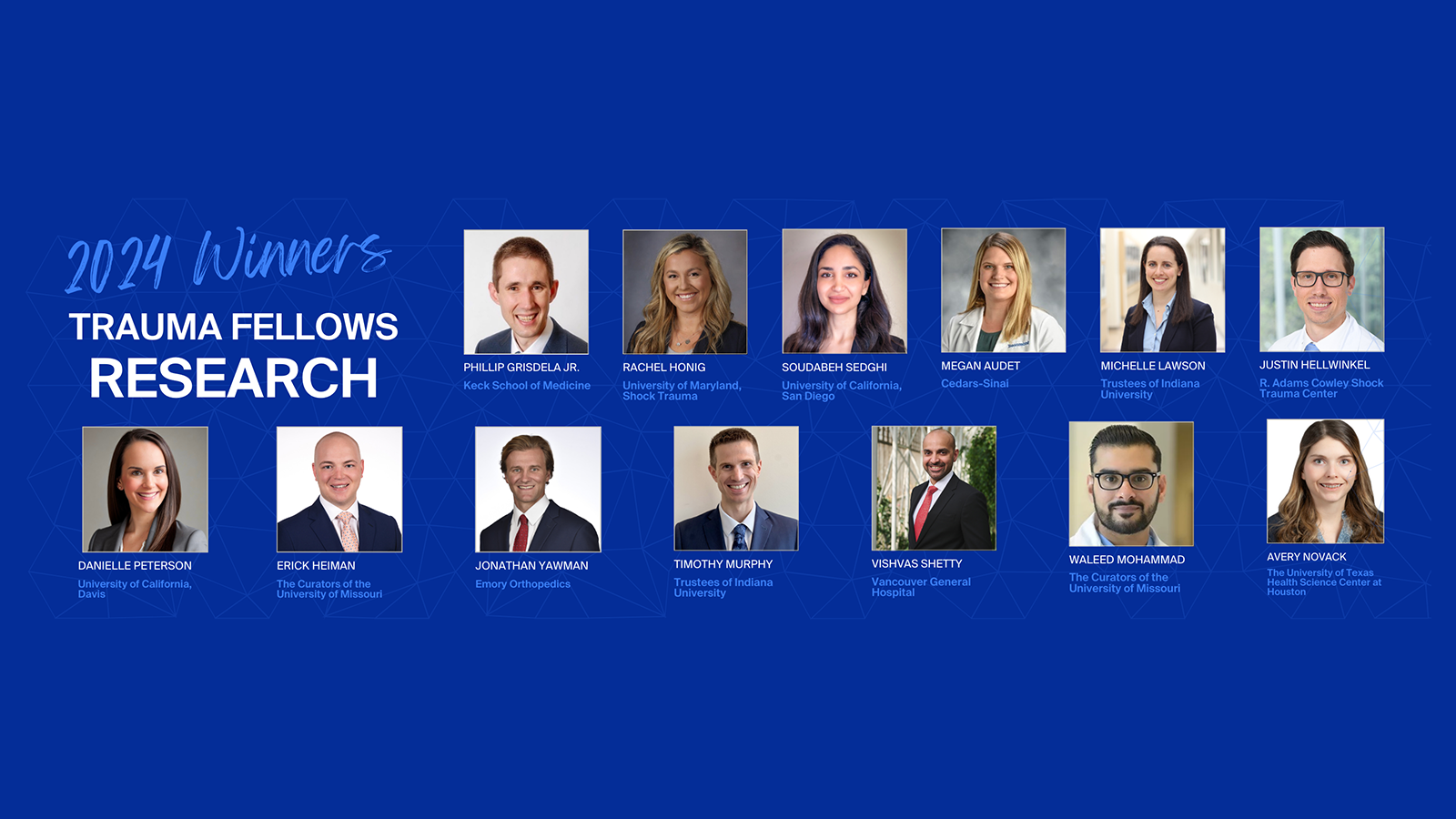
Avrey Novak
School: The University of Texas Health Science Center at Houston
Research: Single-incision intracompartmental leg fasciotomy; technique description and cadaveric validation
Danielle Peterson
School: University of California, Davis
Research: Examining the Impact of Chronic Methamphetamine Use on Fracture Healing
Erick Heiman
School: The Curators of the University of Missouri
Research: A Prospective Longitudinal Cohort Study of Lateral Compression Pelvic Ring Fractures with Continuous Activity Measurement Outcomes
Jonathan Yawman
School: Emory Orthopedics
Research: The Impact of Opioids on Sleep Quality and the Efficacy of a Multimodal Sleep Pathway in Hospitalized Orthopedic Trauma Patients: A Pilot Randomized Controlled Trial
Justin Hellwinkel
School: R. Adams Cowley Shock Trauma Center
Research: Characterization of Gait Changes After Tibia Fractures
Megan Audet
School: Cedars-Sinai
Research: Does Fibular Displacement Predict Tibial Malrotation in a Cadaveric Model?
Michelle Lawson
School: Trustees of Indiana University
Research: The Effect of Lower Extremity Non-union on Gait Speed: A Pilot Study
Phillip Grisdela Jr.
School: Keck School of Medicine
Research: Longitudinal Relationships Between Pain, Depression, and Anxiety in Patients with Lower Extremity Injuries
Rachel Honig
School: University of Maryland, Shock Trauma
Research: A Predictive Model for Preoperative Counseling Using Days at Home and Alive After Geriatric Hip Fracture
Soudabeh Sedghi
School: University of California, San Diego
Research: Biologic Age Versus Chronologic Age in Hip Fracture Surgical Management: A Prospective Cohort Study
Timothy Murphy
School: Trustees of Indiana University
Research: Debridement, Antibiotics, and Implant Retention (DAIR) Versus Debridement, Antibiotics, and Fixation Revision (DAFR) for the Treatment of Fracture-Related Infections
Vishvas Shetty
School: Vancouver General Hospital
Research: BOOST – Blood Flow Restriction Therapy to Optimize Muscle Size and Strength in Recovery from Lower Limb Orthopedic Trauma: A Pilot Study
Waleed Mohammad
School: The Curators of the University of Missouri
Research: Preservation of Infected Osteoarticular Fracture Fragments for Delayed Re-implantation: A Preclinical Canine Model
Advancing Trauma Research
These projects highlight the diverse and innovative approaches being taken to improve trauma care, from optimizing recovery techniques to understanding the effects of substance use and addressing unique surgical challenges. The AO Trauma NA Fellows Research Grant provides essential support to fuel these groundbreaking studies, ensuring that trauma care continues to evolve and improve.
Looking Ahead
Congratulations to all of our grant recipients! Your dedication and research will undoubtedly make a lasting impact on the field of trauma care. For those interested in following in their footsteps, keep an eye out for the 2025 grant application announcements later this year.
Together, we’re pushing the boundaries of trauma research and improving outcomes for patients.